





AGRICULTURE and RURAL DEVELOPMENT ROADMAP TO COUNTER COVID 19 and BEYOND… and make India “THE FOOD FACTORY OF THE WORLD”! through Secured Governance
By Dr. Vivek Damle

Chairman, Savida Agricom Pvt. Ltd.
By Dr. P. Sekhar

Chairman, Global Smart Cities Panel & Micro Tech Global Foundation
Overview of Indian Agriculture
India has made impressive strides on the agricultural front during the last three decades. Much of the credit for this success should go to the several million small farming families that form the backbone of Indian agriculture and economy. Agriculture is the primary source of livelihood for about 58% of India’s population. Gross Value Added by agriculture, forestry and fishing is estimated at INR. 18.55 lakh crore (US$265.51 billion) in FY19 (PE). Growth of agriculture sector has been fluctuating: it increased from -0.2% in 2014-15 to 6.3% in 2016-17, and then declined to 2.8% in 2019-20. Gross fixed capital formation in agriculture decreased from 17.7% of Gross Value Added (GVA) in 2013-14 to 15.2% of GVA in 2017-18.
- • To have cropping models based on the competitive advantage of the each Geography in the country in order to double the farm income.
- • Help Farmers improve productivity through better Agriculture Extension – Efficient and Accountable Lab-Land Program.
- • Agriculture and Industry as partners and double engines for India’s target of US$5 Trillion economy & beyond.
- • Ensuring genuine seeds and pesticides available in the market.
- • Agriculture Markets/APMC’s needs to be really transparent – way beyond what is happening now
- • The state Governments must work with banking and insurance sectors to ensure right credit availability at the right time to the farmer and the rural enterprises so that suicides and other crimes are minimised.
- • Land Reforms - Change of policy to own and lease land in order to get the maximum value of our natural national wealth.
- • Application and use of appropriate technologies available currently and to be developed in future by incorporating traditional wisdom and judicious use of natural resources such as water.
- • There should be no loan waiver melas / popular gestures which cripple the very basis of natural justice among all the citizens of our country.
- • Harnessing India’s demographic dividend by Developing the Quality Human Resource through appropriate education, skill development and continuous improvement by benchmarking with global standards thereby becoming the Human Resources Capital of the World in the coming few decades.
Main Issues
In national priority setting, the following recurring and emerging issues for sustainable agricultural development and poverty alleviation must be considered:
- 1). Population pressure and demographic transition;
- 2). Resource base degradation and water scarcity;
- 3). Investment in agriculture, structural adjustment and impact on the poor;
- 4). Globalization and implication on the poor;
- 5). Modern science and technology and support to research and technology development; and
- 6). Rapid urbanization and urbanization of poverty, and deceleration in rural poverty reduction.
In addressing the above issues, a policy statement on agriculture must take note of the following uncommon opportunities:
- a). Conservation of natural resources and protection of environment.
- b). Vast untapped potential of our soil and water resources, and advanced farming systems;
- c). Technology revolution especially in the areas of molecular biology, biotechnology, space technology, ecology and management.
- d). Revolution in informatics and communication and the opportunity of linking farmers, extension workers and scientists with the national and international databases.
Interdependence of Agriculture Sector
Industry – Industry sector and agriculture sector both is the lifeline of an economy. Agriculture meets people’s demand for food. Industry meets people’s demand for other goods like clothes, houses, electricity, transport etc. Both food and non – food items are essential for living of human beings. As such both industry and agriculture are must for any society. Industry and agriculture are complementary so far as satisfaction of wants of people are concerned. Both must grow simultaneously. Industry alone cannot progress without progress of industry. They are dependent on each other in respect of demand and supply. The population engaged in agriculture needs industrial products. The population engaged in industry needs agricultural products. Industrial production needs raw materials produced by the agricultural sector. There is therefore, a clear-cut interdependence between agriculture and industry.
Agriculture helps industries in the following ways:
- • It provides raw materials for industries;
- • It provides a market for manufactured goods;
- • It provides labour;
- • It provides food for workers working in industries;
- • It can be a source of funds for the industrial sector.
Industries help agriculture in the following ways:
- • They provide seeds of better quality;
- • They provide fertilizers;
- • They help in developing irrigation facilities;
- • They provide pesticides;
- • They supply modern equipment such as tractors;
- • They help in the development of marketing and storage facilities;
- • They supply manufactured goods to workers in the agriculture sector.
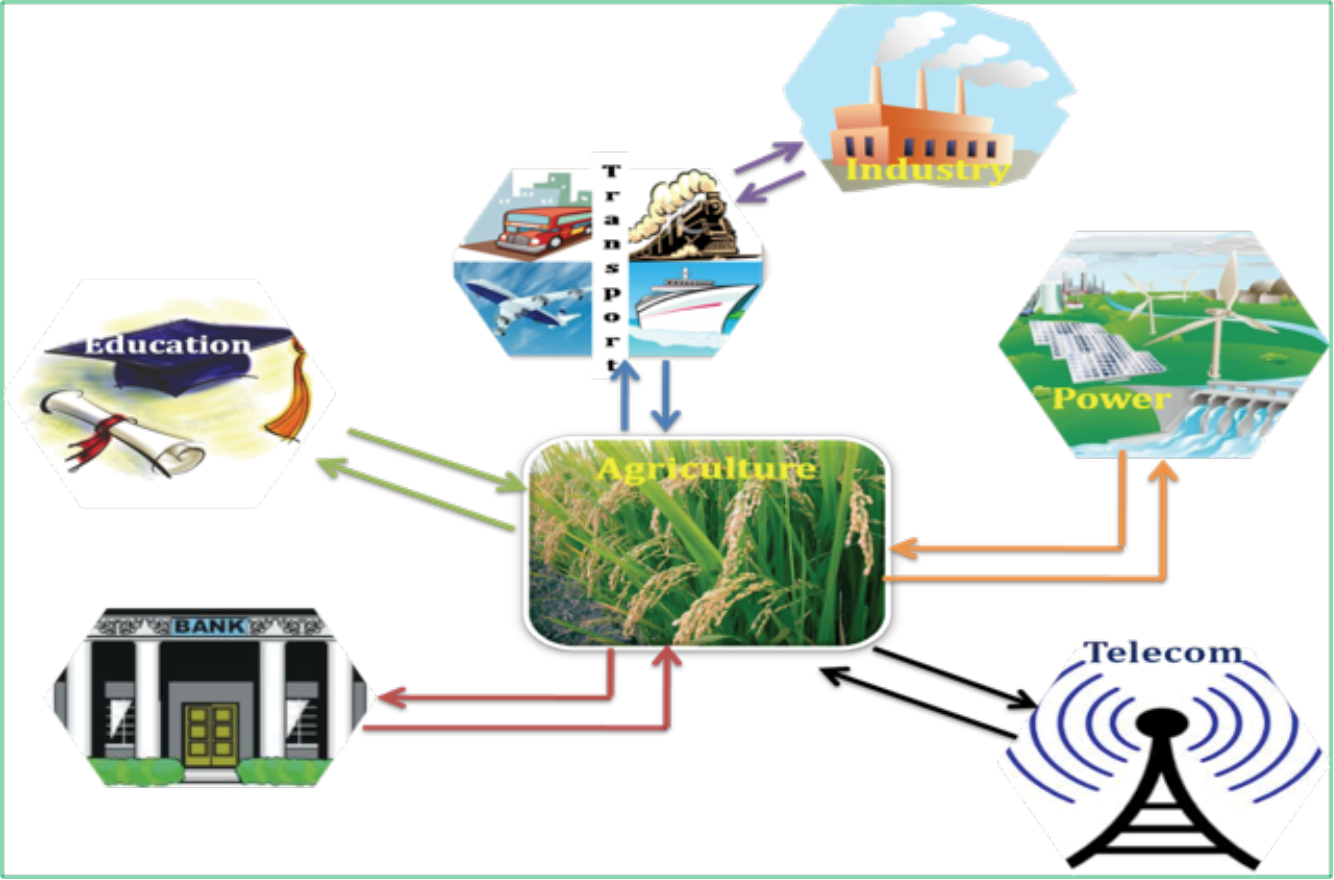
Transportation – The Agriculture Sector is dependent upon the Transportation Systems Sector for movement of commodities, products and livestock. With the development of means of transport and storage facilities, agriculture has become more and more commercial in character. The farmer grows those crops that fetch a better price in the urban market adequate and cheap transport facilities enable the farmers to take their surplus produce to the market rather than dispose it of in the village moneylender-cum-merchant at low prices.
Power Sector – There is a growing demand for electrical energy for irrigation requirements in India. Agriculture is one of the largest consumers of both electricity and water. Very often ground water level falls to such an extent in this state that mining is required to extract water which cannot be replenished by rain. Therefore, most of the electricity used by agriculture goes to pump groundwater. Power is also required to power the equipment needed for agriculture production and food processing.
Banking Sector – Agricultural growth plays an important role in boosting the economic growth of a country; therefore, RRB’s are created as a helping hand to foster the agricultural growth. The function of RRB is to provide loans to the small marginal farmers and agricultural labourers. Timely credit facilities will facilitate the purchase of world class equipment, fertilizers and irrigation can be done more in a scientific way.
Education – Agricultural education and training provides a range of educational activities with the primary aim of achieving human resource development throughout the rural economies of almost all nations.
It covers the learning needs of all parts of the renewable natural resources (RNR) sector, including e.g. forestry, fisheries, and wildlife and land use management. Availability of technically qualified manpower in different disciplines of agriculture is an essential pre-requisite for implementation of development programmes.
Responsibilities of Governance
ICT Role Agriculture & Rural Development
Agriculture is a gigantic sector of the Indian economy as its share to gross domestic product (GDP) is almost 17%. Over 60% of the population adopts agriculture as main occupation. In spite of a large of Indian economy, agriculture is lagging behind many aspects and characterised by poor connectivity and disintegration of market, unreliable and delayed information to the farmers, small land holdings, non-adoption or less adoption of improved technology and so on. It has become indispensable to explore various ways to keep our farmers updated about modern technologies and relevant information. The development and timely dissemination of better personalized technologies specific to different agro-climatic conditions, size of land holding, soil type, type of crops and related pests/diseases is the real issue to brazen out ahead for the agricultural scientists/experts. The timely availability of right information and its proper utilisation is indispensable for agriculture. ICT based initiatives can be taken for propagation of information, transfer of technology, procurement of inputs and selling of outputs in a way so that farmers can be benefitted. The timely information and practical solutions of the agricultural problems helps the farmers to adopt good agricultural practices, make better choices of inputs and to plan the cultivation properly. More over real time social information such as COVID – 19 awareness, preventing methods and minimise the spread level in rural area.
What is Secured Governance?
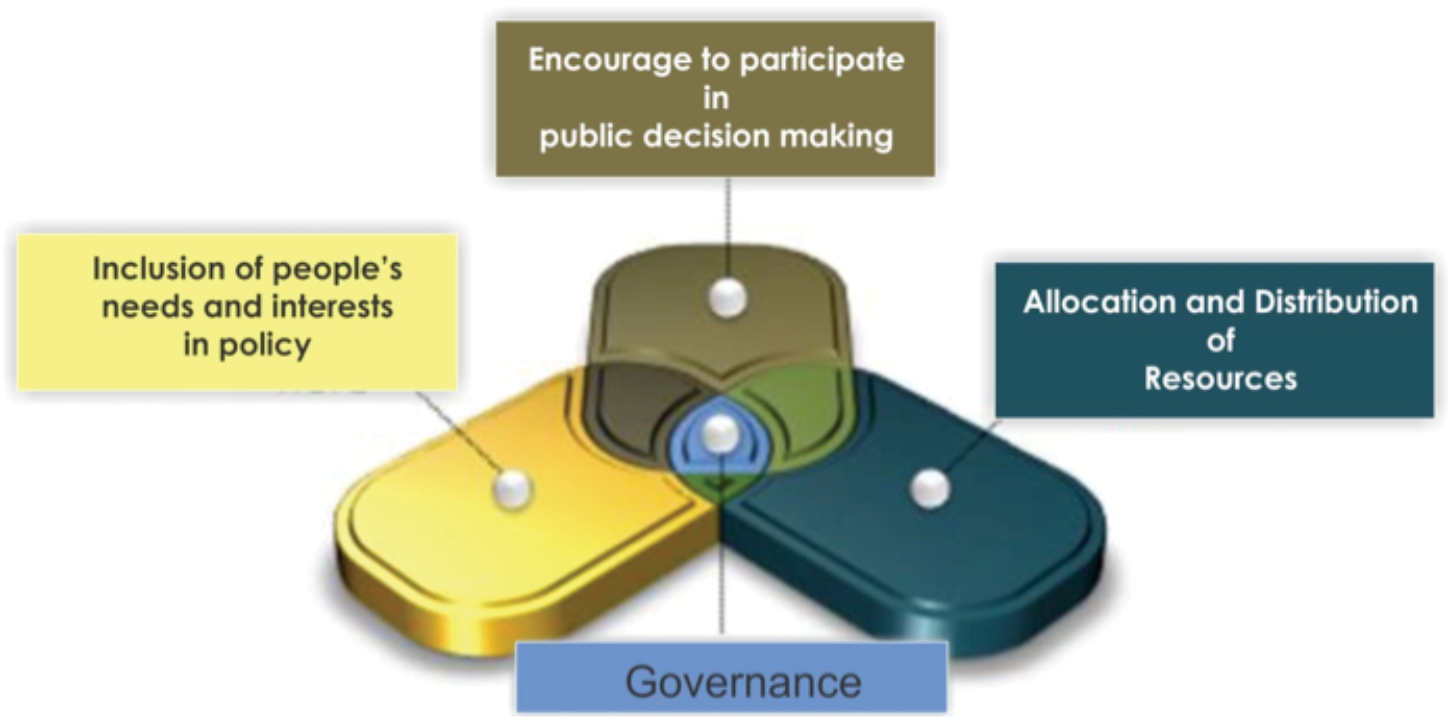
Secured Governance is a structural approach to Governance that enriches cohesion, coherency, and collectiveness to establish secured climate for bringing peace and then to embed stability so that development in any sector can take hold over a long period of time. Only Secured Governance can put down roots deep enough to break the cycle of fragility in all functionalities and bringing in all round participation by concerned organizations and institutions while contributing towards strengthening the process of nation building.
Secured Governance advocates a pragmatic approach of taking advantage of valuation of assets created.
This is not new; we all know when development takes place there is valuation in property. Imagine a model where this valuation can be ploughed back into the project and also benefit the people around. First the cost of the project is reduced, and can actually be at near zero cost to the government if carefully planned. Next the population sees it as benefitting them and so they participate more enthusiastically, helping with early completion of the project rather than being an impediment.
Secured Governance HUBs:- Development of a Primary economic sector (Agricultural HUB) for a defined region with development of a Township or smart city which includes infrastructures such as Residential complexes, Official and Industrial Facilities, Disaster Management System, Power and Water, Sewage and Solid Waste Management, Telecom, Banking, Educational Institutes, Transport facilities and infrastructures, Healthcare, Hospitality Sectors, Retail Market for all including food grains and fruits & vegetables, and other subsidiary Sector.
Secured Governance Compliments the present PPP developmental model by ensuring balanced participation of the private and public sector taking advantage of value and valuation of infrastructure thereby yielding higher returns. This valuation of infrastructure, which grows many folds need to be shared by the society and by the Government to support infrastructure development, ensuring balanced growth. It facilitates an equal opportunity for Private sector and Government to work together with a single window clearance system to achieve greater results to bring National progress with profitability to the participating organizations.
Turning Wasteland into Various Sectorial HUBs for a Sustainable Economic Growth
Due to lack of irrigation, or unfavorable climate, some lands are not cultivated and are categorized as either culturable or unculturable wastelands. culturable wastelands include gullied and / or ravenous land, undulating upland, surface waterlogged land and marsh, salt affected land, shifting cultivation area, degraded forest area, degraded non-forest plantation, sandy area, mining and industrial wasteland, and pasture and grazing lands. Compared to this, unculturable wastelands include barren, rocky, stony wastes, sheet rock area, steep sloping area and snow covered and / or glacial area.
People friendly action programme helps local people and organisations in rehabilitating and improving the degraded lands. The wasteland in India which has been abandoned can be transformed into agricultural HUB for sustainable economic growth. The state government will be responsible for providing the necessary public facilities, while private enterprises and knowledge institutes invest and erect the real estate and the use of public space for critical sectors and other socio – economic activities near the HUB.
Now days, India’s acute housing shortage and rapid urbanization have prompted many economists to prefer more farmland available for housing. This loss of farmland is a direct result of remarkable success in economic development over the past two decades, which has resulted in rapid urbanization and the conversion of enormous amounts of farmland into residential, industrial, commercial, infrastructure and institutional uses. But we need to consider the negative side of farmland losses in this country. The farmland loss may not seem significant in the short term, but added up over the course of decades these losses could have serious effects on the resource base for our food supply. If continued, these high rates of high-productivity farmland loss will have significant impacts over the annual yields of agriculture production.
Negative consequences with conversion of farmland include loses in food production, environmental benefits, and social benefits. With today’s level of agricultural surpluses in this country it is hard to argue that the current rates of farmland conversion will be detrimental to our food supply. However, this may change in the future. Other negative consequences of farmland conversion include reductions in environmental and social benefits.
These environmental benefits include flood control, air quality, habitat for wildlife and native vegetation, and groundwater recharge areas. Social benefits provided by farmland include open space and scenery as well as recreational opportunities such as hunting, fishing, hiking, and photography. Farms make up an important foundation of many regions tourist industry.
Socio-Economic impacts of Land–Use Changes
- • Conversion of farmland and forests to urban development reduces the amount of land available for food and timber production;
- • Soil erosion, salinization, desertification, and other soil degradations associated with agricultural production and deforestation reduce land quality and agricultural productivity;
- • Conversions of farmland and forests to urban development reduce the amount of open space and environmental amenities for local residents;
- • Urban development reduces the “critical mass” of farmland necessary for the economic survival of local agricultural economies;
- • Urban development patterns not only affect the lives of individuals, but also the ways in which society is organized;
- • Urban development has encroached upon some rural communities to such an extent that the community’s identify has been lost;
- • Suburbanization intensifies income segregation and economic disparities among communities;
- • Excessive land use control, however, may hinder the function of market forces;
- • Land use regulations that aim at curbing land development will raise housing prices, making housing less affordable to middle– and low–income households;
- • Land use regulation must strike a balance between private property rights and the public interest.
Population growth, living space and transport infrastructure are considered signs of a country’s prosperity, but they also come at a cost, especially for the environment. We can assume every second one square metre of land is lost to development as new houses, factories, train tracks, roads and other types of infrastructure are built.
So with secured governance new strategies have been formulated to make better use of the land. One of these is the transformation of wasteland into HUB development. The wastelands represent a huge opportunity for infrastructure development. “To carry out these transformations, which we hope will serve as models; the image of those HUBs has had to change too. Urban centres have made huge efforts to improve their quality of life and become economic growth centres.
There are a total of 736 districts in 2020, up from 640 in 2011 census and 593 in 2001. There are around 6 lakh villages in India.
The technology of ICT has opened up more opportunities for businesses in agriculture, also known as “agribusiness” to expand locally and internationally. Today, agribusiness is operated via the Web through the use of the Internet technology and facilities. Thus, with the new technology, it is possible for stakeholders in the agricultural sector to communicate and exchange information between the locals and internationals. The stakeholders are thus known as “agri-community.” One mini HUB would be built up in each district of India and Nano HUBs for all villages. Although farmers have traditional knowledge and expertise in cultivating crops, they lack knowledge of modern trends in production and marketing. More than the production and productivity the farmer needs returns on his investments. Towards this, knowledge on marketing and trade practices are essential. The agricultural HUB, Mini HUB and Nano HUBs will provide him information on this:
- • Implementation of good agricultural practices through live demos, use of modern labour saving equipment & machinery;
- • Production of world class products which could find ready market even outside the country meeting their Phytosanitary (Concerning the health of plants; free from pests and pathogens) requirements;
- • Reduction of production costs enabling the local producers to compete in the world market;
- • This is accomplished through provision of education material in local languages
- • There will be local monitoring through progressive farmers identified among them, who will be constant touch with the providers of the agricultural HUBs;
- • A help line created exclusively for this purpose to serve the speedy communication process.
A Specific Technology Solution to Help Farmers and Food Related Businesses Deal with Market Disruptions Due to COVID-19
A digital platform having the data base of farmers, rural urban artisans, food and allied businesses. This platform will coordinates local and regional food supply chains by matching farm products, capacity and capability with demand and need. It should have the support and involvement of public and private partners /stakeholders across the entire crop value chain, Government being the facilitator and enabler within appropriate regulatory framework. The commonly shared database will allow information to flow seamlessly across digital communities large and small that operate as independent domains. Each business and farm in the data base is represented as a profile that provides details on their respective product characteristics and practices. Profiles are to be kept current by user communities. Profile updates are synchronized across all participating domains, such as farm, producer, or commodity organizations. A Buy Sell Forum will allow for the posting of real time product availability and needs and is communicated to users in the form of trade alerts which will enable a low cost online transactional capability for farmers.
Integrate other Digital Platforms and Strengthen Virtual Outreach and Applied Research Capability so as to develop online training materials and webinars to train farmers and small businesses, helping them to effectively integrate online marketing and other disaster resilience measures. Our network of Indian Council of Agricultural Research (ICAR) and other institutions would coordinate partnerships with community based organizations across the country.
Conclusion
In short, agriculture sector in India have been in acute distress not only because of long term policy fatigue of new economic reforms but also lack of equilibrium between policy changes and awareness regarding policy change among farming community. The government has been controlled prices of agriculture produce through Minimum Support Price (MSP) and export duties for controlling the inflation, but prices of agriculture inputs are according to international market. This dual role of government adversely affects agriculture sector in India. This diplomatic policy should stop by government and try to develop unorganised sector.
Moreover, declining performance of banking sector in rural area, increasing indebtedness, increasing natural hazards, social customs, addiction of alcohol, limited extension of irrigation, large number of marginal and small farmers‟ and low level of income generated through unviable land are major responsible factors for farmers‟ suicide in India. It is indeed, farmer’s community is always worked hard, but they could not get proper return of efforts.
Sustainable Agriculture
- • Puts the emphasis on methods and processes that improve soil productivity while minimizing harmful effects on the climate, soil, water, air, biodiversity and human health;
- • Aims to minimise the use of inputs from non-renewable sources and petroleum-based products and replace them with those from renewable resources;
- • Focuses on local people and their needs, knowledge, skills, socio-cultural values and institutional structures;
- • Ensures that the basic nutritional requirements of current and future generations are met in both quantity and quality terms. Provides long-term employment, an adequate income and dignified and equal working and living conditions for everybody involved in agricultural value chains.
- • Reduces the agricultural sector’s vulnerability to adverse natural conditions (e.g. climate), socioeconomic factors (e.g. strong price fluctuations) and other risks;
- • Fosters sustainable rural institutions that encourage the participation of all shareholders and promote the reconciliation of interests.
- • Connect the research lab to the field – very difficult to grow without the aid of modern scientific research;
- • Pay attention to resource-use efficiency—in water and fertilizers;
- • Restructure the agriculture marketing framework;
- • Farmers need to know about better seeds, proper use of fertilizers and should get access to better technologies.
- • Provide alternative revenue source to farmers as it is difficult to earn a living from small pieces of farm land;
Government has taken initiative for preventing farmers’ suicide but efforts made by them are little compared to intensity of issue. Consequently, the issues of farmers’ suicide have become more serious day by day in India. Many economists also suggests that financial support made by government to victim families cannot solve the problem of farmers’ suicide, but structural changes in the agricultural sector through policy decision is essential to increase confidence among the farmers community in India. Similarly, infrastructural facilities are in weak position. These facilities should be improved, upgraded according to the new trends of marketing and demand supply pattern of the world.
Comments
Vishal P
July 10, 2016 AT 9:15 PM
Vishal P
July 10, 2016 AT 9:15 PM
Leave A Comment