



Unleashing National growth through Strategic Relocations on PSUs through Secured Governance

By Dr. P. Sekhar
Chairman of Global Smart Cities Panel, Micro Tech Global Foundation

Introduction of PSUs & National Growth
Public Sector Undertakings (PSUs) have laid a strong foundation for the industrial development of the country. The public sector is less concerned with making profits. Hence, they play a key role in nation building activities, which take the economy in the right direction. PSUs provide leverage to the Government (their controlling shareholder) to intervene in the economy directly or indirectly to achieve the desired socio-economic objectives and maximize long-term goals. If each PSU home in every new Smart Cities will lead to stimulated production and in turn increased employment opportunity in the defined area. Besides, secured governance compliments the present PPP developmental model by ensuring balanced participation of the private and public sector taking advantage of value and valuation of infrastructure thereby yielding higher returns. This valuation of infrastructure, which grows many folds need to be shared by the society and by the Government to support infrastructure development, ensuring balanced growth.
Smart City in India
Globally urbanisation is ongoing trend which need a strategy design in the form of planned smart cities for proper settlement of people for sustainable economic growth of nation. The social process whereby cities grow and societies become more urban in India is occurring at a breakneck pace. Its cities are expected to grow from 483 million people in 2020 to 607 million by 2030. Urban population in India is presently around 35% of the whole population. It provides more than 60% of India’s GDP. Its contribution will grow to almost 75% within the subsequent 15 years. For many of the Indian cities need to implement the smart city policy to translate into the desired outcomes such as more sustainable, more productive and better-governed cities – is debatable.
 Typically, authorities have been the sole financier of infrastructure projects and have been liable for implementation, operations and maintenance of those projects as they need big scale funding, long incubation duration, and high introductory capital. Still, the authorities solely will no longer be capable of satisfying the rising funding requirements. “Secured Governance offers a strategy for the government to get all the infrastructure development with a negligible investment by the Government. It attempts to work towards close knit growth in all sectors of the economy, without the usual financial constraints that hamper ongoing efforts. It will help enable all that the common man needs to feel secure ─ a safe home and hearth with progress around him, which is what one expects from good governance. Much of the investments for Smart city development will come from Private sector wherein government and its agencies will act as facilitators. This will have a spiraling effect on Global Economy with a defined regions being developed as “Smart Cities or HUBs” and multiple HUBs connecting each other creating a Techno- Economic Corridor. The Mini HUBs and Nano HUBs will be spread over Semi Urban and remote rural regions promoting Industrial development and adoption of modern amenities and technologies to generate additional employment in those areas with minimal rural urban migration and pay rich dividend to elite and rich investors.
The smart city mission introduced by the GoI is an accelerator towards transforming Indian urban cities with the vision to tackle future challenges associated with urbanization and to attract investments, to make these cities sustainable in nature. The focus of the mission in the field of planning is to make cities compact in nature and provide physical and social infrastructure for all sections of the population and integrate modern technology to limit wastage and harness maximum utility. Institutional dimension has been regarded to achieve the above goals with maximum efficiency and transparency through public participation and citizen advisory committee. But, an important question is whether the mission achieves sustainability in its approach; in order to respond to this question, a comparative analysis has been conducted among the indicators of sustainable development and smart city mission in the next section.
Typically, authorities have been the sole financier of infrastructure projects and have been liable for implementation, operations and maintenance of those projects as they need big scale funding, long incubation duration, and high introductory capital. Still, the authorities solely will no longer be capable of satisfying the rising funding requirements. “Secured Governance offers a strategy for the government to get all the infrastructure development with a negligible investment by the Government. It attempts to work towards close knit growth in all sectors of the economy, without the usual financial constraints that hamper ongoing efforts. It will help enable all that the common man needs to feel secure ─ a safe home and hearth with progress around him, which is what one expects from good governance. Much of the investments for Smart city development will come from Private sector wherein government and its agencies will act as facilitators. This will have a spiraling effect on Global Economy with a defined regions being developed as “Smart Cities or HUBs” and multiple HUBs connecting each other creating a Techno- Economic Corridor. The Mini HUBs and Nano HUBs will be spread over Semi Urban and remote rural regions promoting Industrial development and adoption of modern amenities and technologies to generate additional employment in those areas with minimal rural urban migration and pay rich dividend to elite and rich investors.
The smart city mission introduced by the GoI is an accelerator towards transforming Indian urban cities with the vision to tackle future challenges associated with urbanization and to attract investments, to make these cities sustainable in nature. The focus of the mission in the field of planning is to make cities compact in nature and provide physical and social infrastructure for all sections of the population and integrate modern technology to limit wastage and harness maximum utility. Institutional dimension has been regarded to achieve the above goals with maximum efficiency and transparency through public participation and citizen advisory committee. But, an important question is whether the mission achieves sustainability in its approach; in order to respond to this question, a comparative analysis has been conducted among the indicators of sustainable development and smart city mission in the next section.
A smart city is an administrative public system that uses innovative emerging technologies such as information and communication technologies (ICT), Big Data and the Internet of Things (IoT), Geospatial Technology, Blockchain etc. to increase operational efficiency, share information with the public and improve both the quality of government services and citizen welfare. A smart city's success depends on its ability to form a strong relationship between the government -- including its bureaucracy and regulations -- and the private sector.
This relationship is necessary because most of the work that is done to create and maintain a digital, data-driven environment occurs outside of the government. Smart city technology is increasingly being used to improve public safety, from monitoring areas of high crime to improving emergency preparedness with sensors. Modern digital technologies are doing for human brainpower what the steam engine and related technologies did for human muscle power. They’re allowing us to overcome many limitations rapidly and to open up new frontiers with unprecedented speed.
India has undergone rapid urbanization over the last few decades and the witnessing cities are mostly of Class-I & II tiers. To cater the issues developed by this phenomenon, the Public Sector Undertaking Enterprises have taken up initiatives over the years, in the form of programmes that have mainly focused on rapid infrastructure development and utilities to the cities and need to be paid much attention in achieving sustainability in the approach. Recently, India has introduced the smart city mission, which is somewhat on the similar lines of smart development. Since the development is been interpreted differently among the nations due to no standardization of the concept, it’s important to understand how the concept has been represented in the Indian context.
- Exploring the 249 smart city development initiatives taken up by all the CPSUs;
- Exploring indicators of the concepts adopted by the CPSUs;
- Concluding, whether the initiatives taken up by CPSUs are towards achieving sustainability.
Technology Dimension: based on the use of infrastructures (especially ICT) to improve and transform life and work within a city in a relevant way. This dimension includes the concept about Digital City, Virtual City, Information City, Wired City, Ubiquitous City and Intelligent City.
Human Dimension: based on people, education, learning, and knowledge because they are key drivers for the smart city. This dimension includes concepts like Learning City, and Knowledge City. Institutional Dimension: based on governance and policy, because the cooperation between stakeholders and institutional governments is very important to design and implement smart city initiatives. This dimension includes concepts like Smart Community, Sustainable City, and Green City.
Overview of Public Sector Undertaking Enterprises
A state-owned enterprise in India is called a public sector undertaking – PSU or a public sector enterprise. In a PSU company, the majority of the shares 51% or more are owned by the central or state government. Central public sector enterprises are administered by the ministry of heavy industries and public enterprises. As of now, there are 10 Maharatnas, 14 Navratnas, and 73 Miniratnas. There were 339 CPSEs (excluding insurance companies). Of these, 82 enterprises were yet to commence commercial operations. Remaining 257 were operating enterprises (including 179 scheduled CPSEs). The total number of permanent employees employed in Central Public Sector Enterprises were around 15.20 lakh (approx.) of which Managerial/Executives are 2.65 lakh (approx.). The total number of contract workers engaged by CPSE stood at around 3.39 lakh (approx.).
- Total paid up capital in 339 CPSEs as on 31.3.2018 stood at INR. 2,49,988 crore as compared to INR. 2,32,161 crore as on 31.3. 2017 (331 CPSEs), showing a growth of 7.68%.
- Total Investment in all CPSEs stood at INR. 13, 73, 412 crore as on 31.3.2018 compared to INR. 12, 45, 819 crore as on 31.3.2017, recording a growth of 10.24%.
- Capital Employed in all CPSEs stood at INR. 23, 15, 707 crore as on 31.3.2018 compared to INR. 21, 66, 801 crore as on 31.3.2017 showing a growth of 6.87 %.
- Total gross revenue from operation of all CPSEs during 2017-18 stood at INR. 21, 55,948 crore compared to INR. 19, 55,675 crore in the previous year showing a growth of 10.24 %.
Opportunities for CPSUs Participation
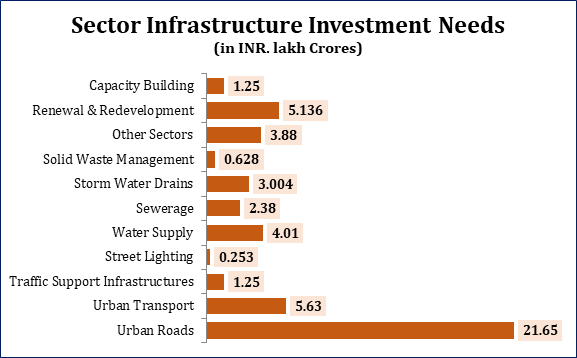
As per various estimates saying that the Investment Requirements for Urban Infrastructure Services report views urban infrastructure opportunity in India to amount to INR. 49.06 lakh crore (US$640 billion, 1US$=INR. 76.66) and the funding gap for infrastructure in India to amount to INR. 7.667 lakh crore (US$100 billion) up to 2030. The programmes will enable the CPSU bodies to help support the Government in infrastructure development – which is a priority considering the inadequate and crippling infrastructure that is rampant across Indian cities. Many ULBs in India do not have sufficient financial resources and skills to provide infrastructure and service delivery. They are increasingly seeking support from the private sector to close the gap. Meanwhile, institutional investors hold substantial assets under management, for which they are seeking attractive investment opportunities. In such an environment, CPSUs can accelerate infrastructure development by using appropriate private sector’s skills in delivering infrastructure and services and leveraging financial resources. The World Economic Forum’s Global Survey on Urban Services revealed that private- and CPSUs collaboration is required in all areas of the urban value chain, including in policy-making, planning, design, implementation, operation and maintenance, and monitoring, as well as in the financing of urban development projects. The survey identified the strategic collaboration as being better positive result oriented agencies to drive the transformation, and respondents suggested greater private sector participation in design, implementation, operation and maintenance, and financing. The recently announced urban rejuvenation programs present an opportunity for private sector to contribute across various urban domains, more so in the physical infrastructure sector in cities.
Sector Infrastructure Investment Needs (in INR. lakh crores)
The suggested scheme of shifting of cash rich CPSUs to one new SMARTCITY each, individual, accountable local employment opportunities will stand generated where the employee will get an opportunity based on his / her competence and capability and they need to continuously deliver to survive in his/her job. Thus the scheme will create sustainable, productive and accountable job opportunities leading to concrete and measurable productivity.
Thus the suggested solution aims at plugging all the experienced ills of the current interventions and at the same time reduce the pollution and traffic congestion in Metros by shifting further influx of population to these new booming centers of economy and move towards an accountable and sustainable society with the added advantage of making the already made investments in SMARTCITIES viable that too by using the idling cash surplus with the cash rich profitable CPSUs as seed capital. The other schemes of Govt. of India may continue as of now but can be dovetailed to meet the big picture.
The shifting of the purse string controllers i.e. the decision makers (the CMD and the Board of Directors) of cash rich CPSUs to new SMARTCITY, will act as a magnet for that city, attracting their vendor partners to follow them for their own pure business reasons .Out of sight – out of business. Hence the vendor partners have to be where the decision makers are. This will thus help the new SMARTCITY to get seeded with paying population that can generate sustainable demand for all essential elements of a thriving city.
Consumption never grows keeping the stock on hand as a driving force but by sentiment. If this was true, a person with a pair of 30 clothes, one for each day of the month, would never have bought the next pair. Instead the person who has 30 pairs is the one who has the intensity to buy more, driven by his raised aspirations to graduate to the next level when the economic environment is conducive. Thus the investments of the cash surplus with the profitable CPSUs in new SMARTCITIES where their decision makers are forced to move, will lead to replication of schools, hospitals, colleges, malls, clubs, retail chains, service outlets etc. as they now have paying population who can afford this. Increased consumption will lead to increased production and in turn increased employment.
With the present compromised quality of life in metros with rising respiratory diseases because of consistently poor air quality with maddening pollution, minimal time left for employees to spend with their families with more than 12 working hrs. a day due to 4 plus hrs. wasted in travelling to and from office with traffic congestion and unaffordability to lease / rent/ buy houses in business districts close to work place , unaffordable cost of schooling, health and living in metros are reasons enough for the shifted employees to soon realize the improvement in their quality of life as well as standard of living at the shifted location . Even otherwise, the change is proposed to be driven by mandating just the CMD and Board of Directors of Cash Rich CPSUs i.e. the decision makers to shift. Many pliant employees will shift to follow their bosses and many will be found willing to opt for such shift when given a choice amongst nationwide employee population for that CPSU. Thus except for the CMD and Directors, for rest of the employees it will be a redistribution by choice with NIL political impact. With close to 30% improvement in bottom-line of the shifted companies with reduced cost of operations due to cheaper real estate , reduced rates of HRA, CCA , Medical bills and improvement in productivity with more energetic and positively oriented employees with reduced time of travel and reduced exhaustion and the top management now consisting of only those who are really interested in professionally running the company than the ones who came on board for the metro location and short term gains, the employees Performance Related Pay / bonus / perks and privileges will see an assured rise.
Comments
Vishal P
July 10, 2016 AT 9:15 PM
Vishal P
July 10, 2016 AT 9:15 PM
Leave A Comment