


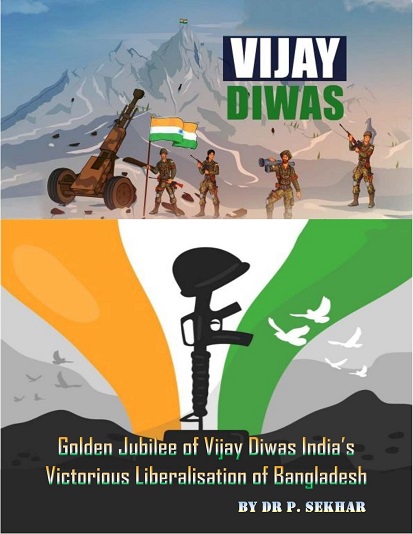
Golden Jubilee of Vijay Diwas India's victorious Liberalisation of Bangladesh
|
|
By Dr P. Sekhar Chairman, Unleashing India Global Smart City Panel & MTGF |
|

Introduction
Vijay Diwas is celebrated in India on December 16 to mark the decisive victory over Pakistan in 1971 which resulted in the creation of Bangladesh and in the liberation of East Pakistan. December 16 every year is celebrated as Vijay Diwas to mark India's glorious victory over Pakistan in the 1971 War. Victory day is national holiday in Bangladesh celebrated on 16 December to commemorate the victory of the Bangladesh forces over the Pakistani forces in the Bangladesh Liberation War in 1971. The Commanding officer of the Pakistani Forces General AAK Niazi surrendered with his forces to the allied forces of Bangladesh, which marked the end of the 9 month-long Bangladesh Liberation War and 1971 Bangladesh genocide and official secession of East Pakistan into Bangladesh. This day and event is also commemorated across India as the "Vijay Diwas" to honor Bangladeshi martyrs who laid down their lives in the war.
History of Vijay Diwas
In 1971 Bangladesh fought the Bangladesh Liberation War against Pakistan to become an independent country, which resulted in the secession of East Pakistan from the Islamic Republic of Pakistan and established the sovereign nation called Bangladesh. The war pitted East Pakistan and India against West Pakistan and lasted for a duration of nine months. One of the most violent wars of the 20th century, it witnessed large-scale atrocities, the exodus of 10 million refugees and the killing of 3 million people by the Pakistani armed forces.

On 16 December 1971, Lieutenant General Amir Abdullah Khan Niazi, CO of Pakistan Armed Forces located in East Pakistan signed the Instrument of Surrender. The Instrument of Surrender was a written agreement that enabled the surrender of the Pakistan Eastern Command in the Bangladesh Liberation War and marked the end of the Indo-Pakistani War of 1971 in the Eastern Theater.
The surrender took place at the Ramna Racecourse in Dhaka on 16 December 1971. Lieutenant General Amir Abdullah Khan Niazi and Lieutenant General Jagjit Singh Aurora, Joint Commander of Indian and Bangladesh Forces, signed the instrument amid thousands of cheering crowds at the racecourse. Air Commodore A. K. Khandker, Deputy Commander-in-Chief of the Bangladesh Armed Forces, and Lieutenant General J F R Jacob of the Indian Eastern Command, acted as witnesses to the surrender. Also present were Vice-Admiral Mohammad Shariff, commander of the Pakistani Naval Eastern Command and Air Vice-Marshal Patrick D. Callaghan of the Pakistan Air Force's Eastern Air Force Command, who signed the agreement. On behalf of Bangladesh, Air Commodore A. K. Khandker acted as witness to the surrender. Lieutenant Jacob Rafael Jacob, Chief of Staff of the Indian Eastern Command, along with the other commanders of Indian naval and air forces, acted as witnesses on behalf of India. Aurora accepted the surrender without a word, while the crowd on the racecourse started shouting anti-Nazi and anti-Pakistan slogans. In 1996, the Bangladesh Bank issued a 10 Taka note with an overprint commemorating Victory Day's Silver Jubilee (the 25th anniversary).
Recognition of Bangladesh
First and foremost, it becomes abundantly clear that India is the first country to have recognized Bangladesh as an independent nation on December 6, 1971, roughly around 11 am. Contrary to some recent trends, Bhutan did not recognize Bangladesh on the same day after a few hours, but rather on the following day on December 7, 1971. As we stated above, this does not belittle Bhutan's generosity in anyway. The people of Bhutan became Bangladesh's lifelong friends due to that. The Surrender of Pakistan Armed Forces marked the end of the Bangladesh Liberation War and the creation of Bangla Desh (later reduced to a single word). Most United Nations member nations were quick to recognise Bangladesh within months of its independence.
Chronological List of 10 countries recognizing Bangladesh
- India, December 6, 1971
- Bhutan, December 7, 1971
- East Germany, January 11, 1972
- Poland, January 12, 1972
- Bulgaria, January 12, 1972
- Myanmar, January 13, 1972
- Nepal, January 16, 1972
- Barbados, January 20, 1972
- Yugoslavia, January 22, 1972
- Tonga, January 25, 1972
[Source: United States Congressional Record]
India-Bangladesh Bilateral Relations
India and Bangladesh share bonds of history, language, culture, and multitude of other commonalities. The excellent bilateral ties reflect an all-encompassing partnership based on sovereignty, equality, trust, and understanding that goes far beyond a strategic partnership.

- The year 2020, despite onset of the COVID-19 pandemic, witnessed intense high level engagements at political and official levels beginning with the exchange of New Year greetings between Prime Minister India and Prime Minister Bangladesh on 01 January 2020.
- The two Prime Ministers held a summit on a virtual platform on 17 December 2020 and discussed all aspects of bilateral relations and exchanged views on regional and international issues. On this occasion, both countries signed seven bilateral instruments in various sectors including hydrocarbons, agriculture, trade, development projects, and conservation of heritage. The two Prime Ministers also jointly unveiled a postal stamp issued by the Government of India to commemorate the birth centenary of Bangabandhu Sheikh Mujibur Rahman. On this occasion, two bilateral projects, Beautification and City Development Project in Rajshahi City and Construction of Khalishpur Collegiate Girl’s School in Khulna were also inaugurated.
- The External Affairs Minister (EAM) of India along with the Foreign Affairs Minister of Bangladesh co-chaired the Joint Consultative Commission (JCC) on a virtual platform on 29 September 2020 and the two Ministers jointly unveiled a commemorative postal stamp issued by the Government of Bangladesh on the 150th birth anniversary of Mahatma Gandhi. The EAM also visited Dhaka in March 2021. The visits of Foreign Secretary
- The exchanges in 2019 included that of the visit of the President of Bangladesh to New Delhi to attend the swearing-in ceremony of PM of India and his cabinet members on 30 May 2019, official visit of PM of Bangladesh to New Delhi on 03-06 October 2019 and to Kolkata to witness historic pink ball test cricket match between India and Bangladesh on 22 November 2019. In addition, the two Prime Ministers also met in a high-level event on the sidelines of 74th session of the UN General Assembly in September 2019 to celebrate the 150th birth anniversary of Mahatma Gandhi.
- In addition to the above high-level engagements between the two countries, there have also been several interactions at senior official level in various bilateral mechanisms. The multi-dimensional cooperation between the two countries ranges from traditional sectors of tourism, health, and education to frontier technologies of nuclear science, space, and information technology.
Security and Border Management:
51st Director General Level Talks (DGLT) between Border Security Force (BSF) and the Border Guard Bangladesh (BGB) were held on 22-26 December 2020 in Guwahati. In addition, border coordination conferences between Regional Commanders of BGB and the Frontier Inspectors General of BSF were also held regularly to discuss management and security of 4096.7 Km of the India- Bangladesh land border.
Defense Cooperation:
High level exchanges in the year 2020 include the second edition of India-Bangladesh CORPAT ‘Bangosagar’ exercise on 03-05 October 2020, Regional Commanders meeting of Coast Guards on 19 October 2020, and the third Annual Defense Dialogue on 02 November 2020. The Indian Army has gifted trained horses and dogs to the Bangladesh Army in November 2020. The Indian Air Chief visited Bangladesh on an official visit in February 2021.
Muktijoddha related engagements and annual visit of Muktijoddhas on the occasion of Victory Day were undertaken in 2020 and scholarships will be distributed to the heirs of Muktijoddhas during January-March 2021. Additionally, Muktijoddha Medical Scheme was implemented for the first time in Bangladesh in 2020.
Connectivity:
Both the governments are undertaking various measures to restore the pre-1965 rail links and other connectivity links that existed between India and Bangladesh. The two Prime Ministers jointly inaugurated the newly restored railway link between Chilahati (Bangladesh) and Haldibari (India) on 17 December 2020. To enhance people to people contacts, the frequency of two passenger trains, i.e., Maitree Express, and Bandhan Express was increased from 4 days a week to 5 days a week and from one day a week to two days a week respectively from February 2020. Both countries also started using side-door container and parcel trains to maintain uninterrupted supply chains during the ongoing COVID-19 pandemic. The Government of India handed over 10 broad guage diesel locomotives as part of grant assistance to Bangladesh Railways in a virtual event joined by Indian External Affairs Minister and Railways Minister and their Bangladeshi counterparts on 27 July 2020. During the visit of Bangladesh PM to New Delhi in October 2019, both the governments decided to commence Dhaka-Siliguri-Gangtok-Dhaka and Dhaka-Siliguri-Darjeeling-Dhaka bus service to enhance people to people contact between both the countries and the trail run of Dhaka-Siliguri-Gangtok-Dhaka was also held in December 2019. Feni Bridge (Maitree Setu) connecting LCS Subroom (Tripura) and LCS Ramgarh (Bangladesh) has been jointly inaugurated on virtual platform by both the Prime Ministers on 09 March 2021.
Second addendum to the Protocol on Inland Water Transit and Trade (PIWTT) was signed in May 2020 for including two new India-Bangladesh Protocol Routes (Sonamura-Daudkandi on river Gomti and extension of Dhulia to Godagiri up to Aricha on river Padma), five new ports of call and two extended ports of call. Sonamura-Daudkandi Protocol Route was also operationalized in September 2020. Trial run of transshipment of Indian goods from Kolkata to Agartala via Chattogram was successfully conducted in July 2020.
Economic and Commercial:
Bangladesh is India’s biggest trade partner in South Asia and India is the second biggest trade partner of Bangladesh. Bilateral trade between India and Bangladesh has grown steadily over the last decade and the exports of Bangladesh have tripled over the last decade to cross US$1 billion in 2018-19. In the FY 2019-20, India’s exports to Bangladesh were US$8.2 billion and imports were US$1.26 billion. Meetings of various institutional mechanisms to promote bilateral trade include that of Secretary level meetings of Commerce and shipping ministries, LCS/ICP infrastructure and establishment of Indian Economic Zone etc. In order to promote cooperation on bilateral trade, an India-Bangladesh CEO’s Forum was launched in December 2020 to provide policy level inputs in various areas of trade and investment and also to facilitate exchanges among the business communities of both the countries. The first meeting of the India-Bangladesh Textile Industry Forum was held in February 2020 to enhance linkages and collaboration in the textile sector.

Power Sector
The sector it has become one of the hallmarks of India- Bangladesh relations. Bangladesh is currently importing 1,160 MW of power from India. The Joint Working Group (JWG)/Joint Steering Committee (JSC) on power provides an institutional framework to promote bilateral cooperation in cross border trade of electricity.
Development Partnership:
Bangladesh is the biggest development partner of India today. India has extended 3 Lines of Credits (LOC) to Bangladesh in the last 8 years amounting to US$ 8 billion for development of infrastructure in various sectors including roads, railways, shipping, and ports. In addition to LOCs, the Government of India has also been providing grant assistance to Bangladesh for various infrastructure projects including construction of Akhaura-Agartala rail link, dredging of inland waterways in Bangladesh and construction of India-Bangladesh Friendship Pipeline.
High Impact Community Development Projects (HICDPs)
These projects constitute an active pillar of India’s development assistance. The Government of India has funded 68 HICDPs including construction of student hostels, academic buildings, skill development and training institutes, cultural centers, and orphanages etc. in Bangladesh and another 16 HICDPs are being implemented.
Capacity Building and Human Resource Development:
Human resource development is a key component of India’s development cooperation efforts in Bangladesh through its several ongoing training programs and scholarships. The Government of India has been training 1800 Bangladesh Civil Service officials from 2019 at National Centre for Good Governance (NCGG), Mussoorie. Bangladeshi police officials are also being trained at various premier training institutes in India on various modern policing and new investigative techniques of this information age. Similarly, the Government of India has been extending training for 1500 Bangladeshi judicial officials since 2017 at National Judicial Academy, Bhopal and at various State Judicial Academies in India. Bangladesh is also an important ITEC partner country and annually around 800 participants from Bangladesh avail the ITEC training courses. In addition, 200 scholarships are awarded by ICCR (Indian Council for Cultural Relations) every year to students from Bangladesh for pursuing under-graduation, post-graduation and M.Phil. / PhD courses in educational institutes of India including the IITs and NIITs.
Cultural Cooperation
The year 2021 will be historic in India-Bangladesh relations as both countries would be commemorating the fiftieth anniversary of the Liberation War and the establishment of diplomatic relations between India and Bangladesh. Both countries are making efforts to jointly organize several activities to commemorate these two epochal events in India, Bangladesh and in other countries.
The Indira Gandhi Cultural Centre (IGCC) in Dhaka plays an important role in celebration of common cultural links between the two countries. Its training programs including Yoga, Kathak, Manipuri dance, Hindi language, Hindustani classical music and the cultural programs of renowned artists of India and Bangladesh contribute in promotion of people to people contacts.
Visas:
In pursuance of the policy of the Government of India to further liberalize Indian visa application process and to strengthen people to people contacts between India and Bangladesh, six new Indian Visa Application Centers (IVACs) were opened in Cumilla, Noakhali, Brahmanbaria, Sathkira, Thakurgaon and Bogura of Bangladesh in 2019 raising the total number of IVACs to 15. In 2019, the number of visas issued to Bangladeshi citizens crossed the mark of 16 lakh. Opening of two new Assistant High Commissions in Khulna and Sylhet in 2019 has also helped in facilitating an efficient and quick visa processing for Bangladeshi nationals. Both countries have commenced a temporary air travel bubble to facilitate the urgent requirements of travelers of India and Bangladesh during the COVID-19 pandemic.
Cooperation to tackle the challenge of COVID-19 pandemic:
Prime Minister of Bangladesh participated in the video conference of Leaders of SAARC countries on 15 March 2020 at the invitation of Indian Prime Minister to share assessments of the current situation relating to this pandemic, consider best practices, and identify cooperative measures to minimize and mitigate the spread of the disease. As part of bilateral assistance, the Government of India has extended three tranches of medical assistance including 30,000 surgical masks, 15,000 head covers, 50,000 surgical latex gloves, 100,000 Hydroxychloroquine medicine tablets and RT-PCR test kits capable of running 30,000 tests in March- April 2020 to Bangladesh to assist in its efforts to fight against the COVID pandemic. The Government of India has also been conducting various online training modules to train the health professionals of Bangladesh on treatment and care of COVID patients.
In January 2021, the Government of India gifted 2 million Covishield (Oxford-AstraZeneca vaccines) to Bangladesh to assist in its efforts to fight against the pandemic. The Government of Bangladesh, BEXIMCO Pharmaceuticals Limited of Bangladesh and the Serum Institute of India (SII) have signed a trilateral MOU to procure 3 crore doses of COVID-19 vaccine from the SII.
Conclusion
Two major pillars of Indian diplomacy — Neighbourhood First and Act East policies — find expression in India’s vibrant ties with Bangladesh. Noting that this year is of special significance for India-Bangladesh relations, a senior official quoted the Indian Prime Minister as saying that this year marks a “Triveni of events of epochal significance — the golden jubilee of the Liberation War of Bangladesh, the birth centenary of Bangabandhu Sheikh Mujibur Rahman and the 50th anniversary of our diplomatic ties. India-Bangladesh relations today are deeper than any other strategic partnership. It is a role model for relations between two neighbouring countries. The spirit of friendship, understanding and mutual respect engendered during the liberation of Bangladesh continues to permeate different aspects of this relationship. India and Bangladesh share a Sonali Adhyay’ or Golden Era — a relationship geared towards bringing stability and prosperity to people on both sides of the border.
Comments
Vishal P
July 10, 2016 AT 9:15 PM
Vishal P
July 10, 2016 AT 9:15 PM
Leave A Comment